Pool Water-Feature Troubleshooting
Three Easy Ways to Check For a Pool Waterfall Leak
Confirm water loss, inspect the back of the waterfall, and compare controlled tests with the water feature off and running.

How can you check whether a pool waterfall leaks?
First confirm that the pool loses more than evaporation with the waterfall off. Inspect behind and around the feature for water escaping through grout, joints, fittings, or the structure. Then compare equal-duration tests with the waterfall off and on under similar weather. Loss that appears only—or increases materially—while it runs strongly points to the water feature, although further isolation may be needed to identify the exact component.
Does Your Pool Waterfall Leak?
You’re here because your pool has a leak and you want to rule out the waterfall.
Your backyard pool oasis is a tricky thing! The soil shifts, the weather constantly changes from freezing to 100 degrees or more, and your pool pipes don’t stand a chance.
But when your pool leaks, how can you tell where the leak is coming from?
In most cases, you’ll need to call a leak detection professional. But for many waterfalls and water features, even pool leak detection companies need to run diagnostics that may take a day or two.
Why might a Pool Waterfall Leak Be Difficult to Find?
Pool waterfalls and water features are often built in a way that makes it impossible to pressure test.
If your observations narrow the problem to a waterfall, share them before the appointment. True Blue can advise whether a targeted investigation or repair visit is appropriate and explain the applicable fee.
Who doesn’t want to save an extra few hundred bucks?
So, without further ado, here are the steps to determining if you have a pool waterfall leak or not.
Step One – Determine that your pool has a leak.
Before you check if you have a pool waterfall leak, ensure your pool is losing water from a leak first. We saw evaporation levels as high as 1/4″ per day this winter and over 1/2″ in the summers.
That’s insane! But it’s true. So it may seem like you have a pool leak because you are filling up your pool more, but you may not.
And you know what we really hate… charging people for a pool leak detection just to tell them they don’t actually have a leak. It makes us sad.
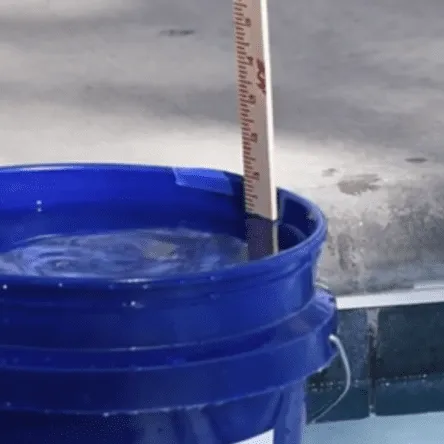
So, if you haven’t done a bucket test, do that first:
Click here to watch our video on how to do a bucket test
Even substantial daily water loss should be compared with evaporation. A bucket test gives useful context before you assume the waterfall or plumbing is leaking.
Step Two – Look Around the Back of Your Waterfall
Look for unintended water escaping through grout or joints behind the waterfall. This is a useful clue, but the repair still needs to address the actual water path rather than relying on the location of a wet spot.
Ask a qualified pool or masonry professional to inspect the waterfall before choosing a repair. Visible leakage may involve grout, waterproofing, or hidden plumbing; regrouting alone will not fix every cause.
If you are a DIYer, check out some threads like TroubleFreePool.com to get a great start on pool water feature grouting!
And to be sure, after you’ve had that repair done, then do the bucket test again to make sure. Oftentimes, pools may have multiple leaks.
Step Three – Do a Bucket Test With The Pool Waterfall Off and Then With It On
This is important. And also a little tricky.
It’s important because it compares the water loss from when the water features are running and when they are off.
It’s tricky because the pool will lose water faster with evaporation when the waterfalls are running.
So, if the pool loses a tiny bit of water when the waterfalls are on, it’s probably not your pool waterfall leak.
If water loss increases noticeably while the feature runs, the feature system deserves closer investigation. Compare similar weather and operating conditions, because waterfall evaporation and splash-out can also increase losses.
*** Important Note
If your pool waterfall or features are on a separate pump, there is one extra step you have to take.
Most water features run on the same pump that runs the entire pool system. So you most likely won’t have to follow this step.
If the water features have a separate pump, tell the technician. Additional circuit-isolation testing may be useful. Do not remove pump lids or change unfamiliar valve settings; a professional should shut down, depressurize, and isolate the system safely.
Once a qualified professional has confirmed a safe test configuration, repeat the 24-hour bucket comparison and record the result.
That’s it! Share your observations with the technician rather than treating any one result as a final diagnosis.
If you do these tests, tell your leak detection expert what you’ve found, and you will be able to save time and money and feel like your own leak detection expert. After all, nobody knows your pool better than you do!
I Do Not Have A Pool Waterfall Leak… What Next?
Before calling an expert, there are many more steps you can take. There are more resources here at True Blue on our blog page, like “6 Simple Tips on How to Tell if your Pool is Leaking.“
Make sure to take advantage of all of our resources to save you time and money. You can also give us a call and we will help you troubleshoot your pool over the phone if possible.
If you feel ready to call for an expert, go to our online appointment link here or call us at 214-326-2634.
Pool Waterfall Leak FAQ
Does water behind a pool waterfall always mean the grout failed?
No. Grout or mortar may be involved, but water can also escape through the waterproofing, liner or pan, supply plumbing, fittings, rock joints, or the feature’s structure. Determine the path before choosing a repair.
Can pool-waterfall plumbing be pressure-tested?
Sometimes. A dedicated closed supply line may be testable, while an open trough, spillway, or inaccessible network may require operational isolation, dye testing, visual inspection, or another method. Construction determines the appropriate test.
How should waterfall-on and waterfall-off tests be compared?
Use equal test durations, start from documented water levels, disable automatic fill, note rain and weather, and keep unrelated equipment settings consistent. Repeating the comparison can reduce the chance that evaporation or measurement error explains a small difference.
Is it safe to remove a separate water-feature pump lid?
Only after disconnecting power, isolating the correct suction and return paths, relieving pressure, and confirming that the equipment will not gravity-flood. Do not open energized or pressurized equipment; use a pool professional if the plumbing layout is unclear.